
The Lenten Fast: Housekeeping for the Heart — Lanier Ivester
by Lanier Ivester
Is this a fast, to keep The larder lean? And clean From fat of veals and sheep? Is it to quit the dish Of flesh, yet still To fill The platter high with fish? Is it to fast an hour, Or ragg’d to go, Or show A downcast look and sour? No; ‘tis a fast to dole Thy sheaf of wheat, And meat, Unto the hungry soul. It is to fast from strife, From old debate And hate; To circumcise thy life. To show a heart grief-rent; To starve thy sin, Not bin; And that’s to keep thy Lent.
— Robert Herrick, To Keep a True Lent
The first time Philip and I observed the Lenten fast we were in our mid-thirties. Having both been raised Baptist we were unacquainted with many of the feasts and fasts that comprise the traditional church year, but we wanted, as countless Christians before us, to embody this yearly journey to Holy Week in a way that kept us viscerally tethered to its implications. We wanted, in other words, to remember; to be pricked out of our complacency by the absence of some ordinary thing we were not used to going without. Sweets were a natural choice, for although we don’t eat a lot of sugar, Philip loves a bowl of ice cream after dinner, and I always have a pip of good, dark chocolate on my tea tray in the afternoons. It seemed a wholesome thing—honestly, occasionally an irksome one—to leave the chocolate on the pantry shelf when I made my tea each day, and I tried to be mindful of the actual sufferings of Jesus even as I squirmed under the extremely mild discomfort of my own frailty.
We were not aware that when Pope Gregory established the beginning and duration of Lent in AD 601 he also made provision for a small reprieve: the 6 Sundays between Ash Wednesday and Easter were to be treated as little feast days in which penitent parishioners might break their fast and look toward the glorious good news of the Resurrection. Thus it was that we went without the least grain of sugar for 46 days, and we were joined in our experiment by our friends Gary and Rachel and their three small daughters.
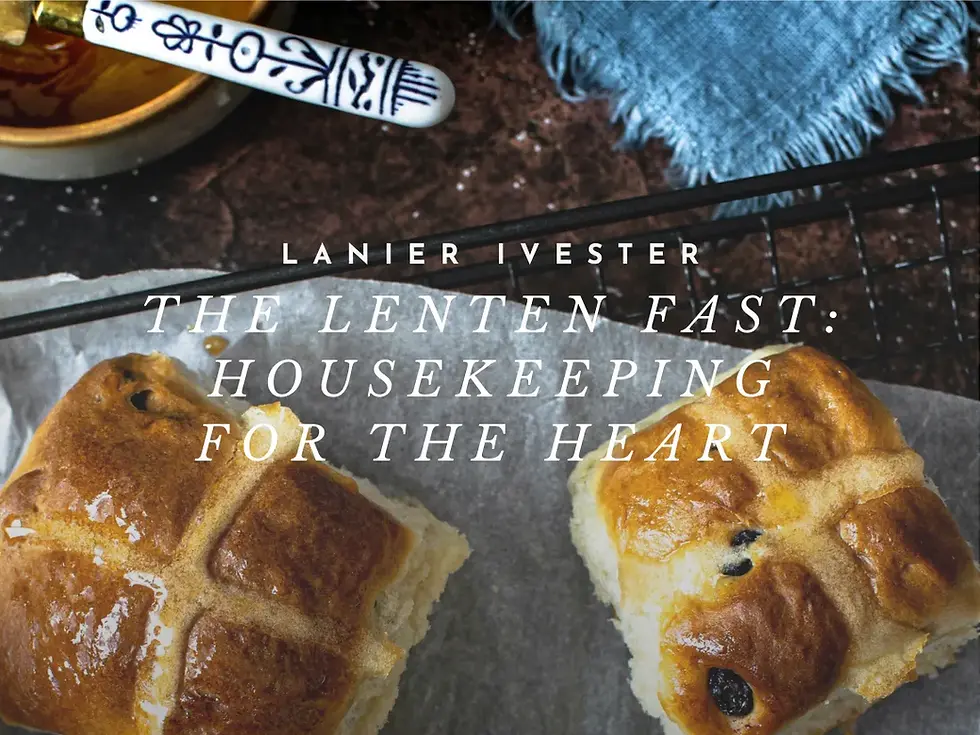
On Easter Sunday I invited the Browns for brunch after early service. I made hot cross buns and Rachel brought muffins and the kitchen table was piled high with bowls of Easter candy—the kind of junk I would never buy in my right mind. But in this post-abstention delirium, not to mention the nostalgia of Easter Sunday itself, I went wild: malted eggs and Cadbury Creams, Reese’s Peanut Butter Cups and those disgusting iterations of marshmallow fluff and hot-pink dye known as “Peeps.” We feasted and made merry, and we all got a little punchy, I’m afraid, on this sudden infusion of high-fructose corn syrup after so many days of self-denial. And then we all felt a little sick. Philip and I were due at my parents’ house for Easter Dinner in a few hours. But all I wanted to do was crawl into bed.
In the years since I’ve learned to moderate a bit in coming off of a fast. I’ve also learned to appreciate those 6 Sundays as a way of tempering my very first-born, Type-A tendencies toward legalism. Once, when I’d given up wine for Lent, we went out to eat on a Saturday night with our dear friends Luke and Laura. When I passed on the pre-dinner drink, they completely understood. But Luke leaned forward on his elbow with a raised eyebrow and a roguish smile.
“You know,” he said in his husky drawl, “it’s Sunday in Oxford.”
As anyone close to me would know, Oxford is the city of my heart, a place in which I’ve left a part of myself to retrieve each time I return. Besides, seeing as I was enrolled at the time in a mostly distance-learning course of study at the University, he had a point. I thought of all those cobbled squares and limestone facades sleeping under the moonlight across the sea. Then I ordered a glass of prosecco, and when it came I lifted it to my friends in the name of grace and good company.
The point, of course, is not to look for loopholes in our devotional practices, or, worse yet, to try and impress God with our religious stamina. The gift of the Lenten fast is presence to the supreme mysteries of the Cross and the love of God. When we deny ourselves we acknowledge our part in the murder of Jesus Christ and our desperate need of a redemption beyond human power to procure; when we break fast, even for the 6 little feast days of Lent, we affirm that our Redeemer lives and loves us past human expression.
Throughout Christian history men and women have fasted for various reasons: repentance, grief, national emergencies, revelation. For while the corporate fast was only mandated once in Scripture, on Yom Kippur or the Day of Atonement, voluntary fasting is a practice that is assumed throughout both the Old and New Testaments. When you fast, Jesus tells us, not “if.” This does not mean, however, that there is only one way to fast. Rachel has inspired me to give up everything from novels to discretionary spending for Lent. Laura once famously gave up snark. During a particularly challenging season of my life I committed to stop complaining; I am chagrined to admit that this was probably the most difficult and least successful fast I have ever undertaken.
We must remember, though, that the point of a fast is not self-improvement, but self-awareness, and the posture of humility to which such knowledge should bring us. If we choose to observe the Lenten fast, we shouldn’t muster our willpower so much as fall on our knees.
I once mentioned to Philip that I was praying about what to give up for Lent.
“That’s great, baby,” he said, with a twinkle in his blue eyes, “but I don’t think God really cares.”
I was taken aback. But after my Type-A sensibilities settled down somewhat I began to see what he meant. Of course God doesn’t care what we give up for Lent, or if we give up anything, for that matter. He is not waiting for us to push the right button or peek behind the right door. Fasting does not cajole God closer to us—he is already closer than our next breath and nearer than our own hands and feet, to paraphrase Tennyson. As with all the spiritual disciplines, the point of a fast is to willingly clear the debris of our own distraction, self-absorption, self-reliance, indifference, from the channel of communion between our souls and our God. It is a bit of housekeeping for the heart, for as with the sister fast of Advent, we are preparing room for a Guest who is already in our midst.
Traditionally, fasting, almsgiving, and prayer make up a triumvirate of Lenten disciplines. These are taken from Jesus’s Sermon on the Mount in Matthew 6, and the golden thread running through them is secrecy. When you give, “do not let your left hand know what your right hand is doing.” When you pray, go into your closet and shut the door. When you fast, wash your face and keep up your appearance. Contrary to the showy demonstrations of the Pharisees, fasting is meant to be a supremely intimate ceremony between the soul and her Savior. It is not about appeasement or even earning Easter joy. The fruit of a true fast, great or small, is always love.
Lanier Ivester is a homemaker and writer in the beautiful state of Georgia, where she maintains a small farm with her husband, Philip, and an ever-expanding menagerie of cats, dogs, sheep, goats, chickens, ducks, and peacocks. She studied English Literature at the University of Oxford, and her special area of interest is the sacramental nature of everyday life. For over a decade she has kept a web journal at lanierivester.com, and her work has also been featured in The Rabbit Room, Art House America, The Gospel Coalition, and The Cultivating Project, among others.


